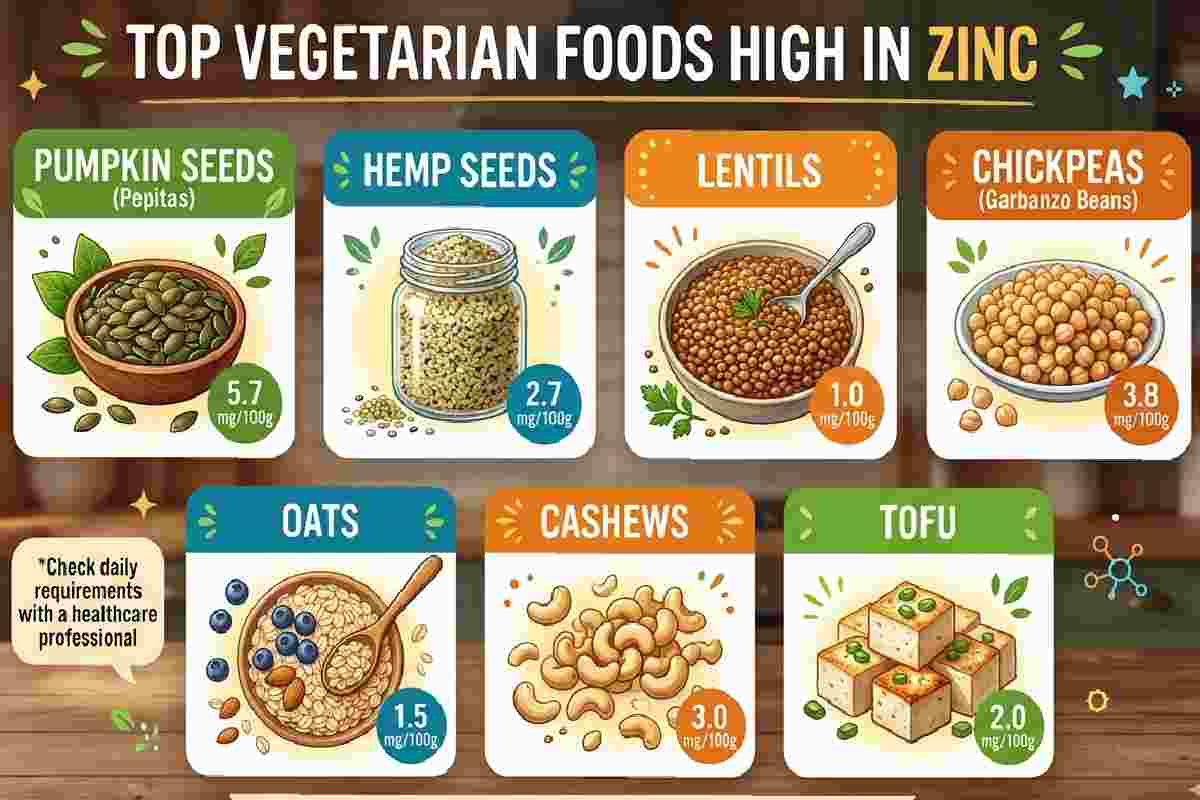


Zinc is an indispensable mineral that is required in immunity, wound healing, metabolism, and skin. Although it is believed that zinc can only be obtained in meat and seafood, vegetarians can still achieve their daily needs through plant-based foods, which include pumpkin seeds, chickpeas, lentils, nuts, whole grains, and fortified cereals. Plant zinc is however not absorbed effectively and therefore to enhance its absorption vegetarians must incorporate variety, soaking, sprouting, as well as foods rich in vitamin C.
Why Zinc Is Important for the Body
Zinc plays a crucial role in over 300 enzymatic reactions in the body. It supports several vital functions:
- Immune system support
- Wound healing
- DNA synthesis
- Hormone regulation
- Healthy skin and hair
- Normal growth and development
According to the National Institutes of Health, adults typically need:
| Group | Recommended Daily Zinc Intake |
| Adult Men | 11 mg |
| Adult Women | 8 mg |
| Pregnant Women | 11 mg |
| Breastfeeding Women | 12 mg |
Vegetarians may require up to 50% more zinc because plant foods contain compounds like phytates that reduce zinc absorption.
Avocados are a nutritious addition to a vegetarian diet because they provide healthy fats, fiber, and potassium alongside small amounts of zinc. To explore more potassium-rich options, check out this guide to foods high in potassium.
Top Zinc Rich Foods Vegetarian Diets Should Include
- Pumpkin Seeds
Pumpkin seeds are one of the highest zinc-containing plant foods.
Benefits:
- Rich in magnesium and antioxidants
- Supports heart health
- Good protein source
Zinc content: ~2.2 mg per 28 g
- Chickpeas
Chickpeas are extremely versatile and commonly used in vegetarian diets.
Benefits:
- High in protein and fiber
- Helps control blood sugar
- Supports digestive health
Zinc content: ~1.3 mg per cup cooked
- Lentils
Lentils are staple vegetarian protein sources.
Benefits:
- Excellent plant protein
- Rich in iron and folate
- Supports heart health
Zinc content: ~1.3 mg per cup cooked
- Hemp Seeds
Hemp seeds are nutrient-dense superfoods.
Benefits:
- Complete protein
- Healthy omega fats
- Supports brain function
Zinc content: ~3 mg per 3 tablespoons
- Cashews
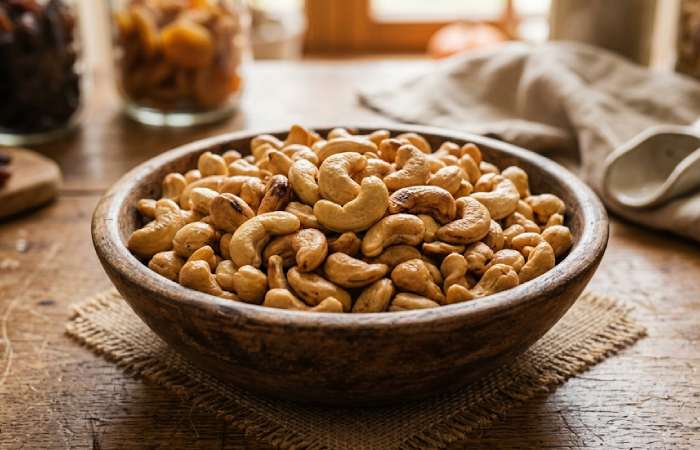
Cashews provide both zinc and healthy fats.
Benefits:
- Supports brain health
- Improves energy levels
- Contains antioxidants
Zinc content: ~1.6 mg per 28 g
- Oats
Whole grains like oats provide moderate zinc levels.
Benefits:
- Supports heart health
- High in soluble fiber
- Helps lower cholesterol
Zinc content: ~2.3 mg per cup
- Quinoa
Quinoa is a complete protein grain ideal for vegetarian diets.
Benefits:
- Contains all essential amino acids
- Gluten-free
- Rich in magnesium and iron
Zinc content: ~2 mg per cup cooked
Fermented foods can add variety to a balanced vegetarian diet and support digestive health. Discover traditional and everyday options in this guide to the top 20 probiotic foods in India.
Zinc Rich Vegetarian Foods Comparison Table
| Food | Zinc per Serving | Additional Benefits |
| Pumpkin Seeds | 2.2 mg | Heart health, antioxidants |
| Chickpeas | 1.3 mg | Protein, digestive health |
| Lentils | 1.3 mg | Iron, fiber |
| Hemp Seeds | 3 mg | Omega fatty acids |
| Cashews | 1.6 mg | Brain health |
| Oats | 2.3 mg | Cholesterol control |
| Quinoa | 2 mg | Complete protein |
Tips to Improve Zinc Absorption for Vegetarians
Plant foods contain phytates, which can reduce zinc absorption. Fortunately, simple preparation methods can help.
- Soaking
Soaking beans, grains, and seeds reduces phytates.
- Sprouting
Sprouted legumes increase mineral bioavailability.
- Fermentation
Fermented foods like tempeh and sourdough improve zinc absorption.
- Combine with Vitamin C
Pair zinc foods with vitamin C sources like:
- Citrus fruits
- Tomatoes
- Bell peppers
Planning balanced meals for the whole household can make it easier to include zinc-rich legumes, whole grains, nuts, seeds, and vegetables regularly. For more meal-planning inspiration, explore these whole foods family meals.
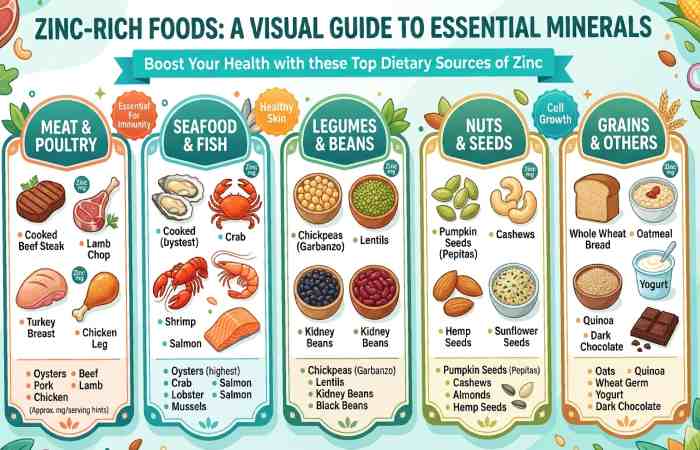
Zinc-rich Foods Chart
Signs of Zinc Deficiency
Zinc deficiency can occur if intake is too low.
Common symptoms include:
- Frequent infections
- Slow wound healing
- Hair loss
- Skin problems
- Loss of taste or smell
- Fatigue
Vegetarians should monitor intake carefully to avoid deficiencies.
Legumes, lentils, chickpeas, pumpkin seeds, and leafy greens provide a range of nutrients that contribute to a balanced vegetarian diet, including zinc and iron in varying amounts. For more iron-focused food ideas, see this top 10 hemoglobin food chart.
Country-Wise Vegetarian Zinc Supplement & Food Product Prices
India
| Product | Approx Price | Resource Link |
| Tata Sampann Pumpkin Seeds | ₹250 | https://www.amazon.in |
| Nutraj California Almonds | ₹650 | https://www.flipkart.com |
| True Elements Oats | ₹200 | https://www.amazon.in |
United States
| Product | Approx Price | Resource Link |
| Nature’s Garden Pumpkin Seeds | $8 | https://www.amazon.com |
| Bob’s Red Mill Oats | $6 | https://www.amazon.com |
| Anthony’s Organic Chickpeas | $12 | https://www.amazon.com |
United Kingdom
| Product | Approx Price | Resource Link |
| Linwoods Pumpkin Seeds | £5 | https://www.amazon.co.uk |
| Quaker Oats | £3 | https://www.tesco.com |
| Merchant Gourmet Lentils | £2 | https://www.amazon.co.uk |
Canada
| Product | Approx Price | Resource Link |
| Yupik Pumpkin Seeds | CAD $9 | https://www.amazon.ca |
| One Degree Sprouted Oats | CAD $7 | https://www.amazon.ca |
| Goya Chickpeas | CAD $3 | https://www.walmart.ca |
Australia
| Product | Approx Price | Resource Link |
| Honest to Goodness Pumpkin Seeds | AUD $8 | https://www.amazon.com.au |
| Uncle Toby’s Oats | AUD $4 | https://www.woolworths.com.au |
| Macro Organic Chickpeas | AUD $3 | https://www.woolworths.com.au |
Best Vegetarian Zinc Supplements Comparison
| Supplement | Zinc Amount | Price | Resource |
| Garden of Life Zinc | 30 mg | $15 | https://www.amazon.com |
| Nature Made Zinc | 30 mg | $10 | https://www.amazon.com |
| NOW Foods Zinc Picolinate | 50 mg | $12 | https://www.amazon.com |
While sweetened drinks and flavored creamers can be enjoyed occasionally, they should not replace nutrient-dense foods such as nuts, seeds, legumes, and whole grains. If you enjoy creative beverage ideas, take a look at this Dirty Dr Pepper creamer recipe.
Zinc-rich Fruits
Fruits do not contain zinc in the richest forms compared to the seeds, legumes and nuts. Nevertheless, a few fruits still contain small quantities, though useful portions of zinc that should be added to daily consumption with other zinc-rich vegetarian products. The following are some fruits with zinc content that can be used to complete a balanced vegetarian diet.
Avocado
Avocado is one of the most nutrient-dense fruits and provides a small amount of zinc along with healthy fats.
Zinc content: ~0.6 mg per medium avocado
Other nutrients:
- Healthy monounsaturated fats
- Potassium
- Vitamin E
- Fiber
How to eat:
- Add to smoothies
- Spread on toast
- Use in salads or guacamole
Blackberries
Blackberries contain small amounts of zinc but are also packed with antioxidants and fiber.
Zinc content: ~0.5 mg per cup
Benefits:
- Supports immune health
- High in vitamin C
- Rich in antioxidants
Best ways to consume:
- In yogurt or smoothies
- Fresh fruit bowls
- Oatmeal topping
Pomegranate
Pomegranate provides trace zinc along with powerful antioxidants.
Zinc content: ~0.4 mg per cup
Health benefits:
- Supports heart health
- Rich in polyphenols
- Helps reduce inflammation
How to eat:
- Sprinkle seeds over salads
- Add to smoothies
- Eat fresh as a snack
Raspberries
Raspberries contain small amounts of zinc and are excellent for digestive health.
Zinc content: ~0.5 mg per cup
Other nutrients:
- High fiber
- Vitamin C
- Antioxidants
Serving ideas:
- Smoothies
- Breakfast cereals
- Fruit salads
Kiwi
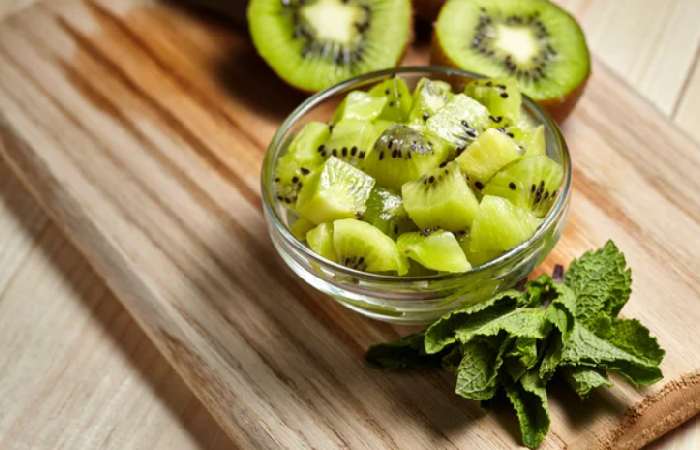
Kiwi provides a small amount of zinc but is extremely rich in vitamin C, which supports immunity.
Zinc content: ~0.2 mg per fruit
Benefits:
- Boosts immune system
- Supports digestion
- High vitamin C
Best ways to eat:
- Fruit bowls
- Smoothies
- Fresh snack
Zinc Content Comparison of Fruits
| Fruit | Zinc per Serving | Key Benefits |
| Avocado | ~0.6 mg | Healthy fats, heart health |
| Blackberries | ~0.5 mg | Antioxidants, immune support |
| Raspberries | ~0.5 mg | Fiber, digestion |
| Pomegranate | ~0.4 mg | Anti-inflammatory |
| Kiwi | ~0.2 mg | Vitamin C boost |
Choosing minimally processed foods such as oats, lentils, chickpeas, nuts, and seeds can help improve the nutritional quality of a vegetarian diet. Learn more about the differences between healthy food vs. junk food when making everyday food choices.
7-Day Vegetarian Zinc Meal Plan
Zinc can easily be obtained in an adequate amount in a properly planned vegetarian diet, when the meal contains legumes, seeds, nuts, whole grains, and dairy or fortified foods. This 7-day zinc vegetarian meal plan is based on the balanced meals, which assist in supporting immunity, metabolism and health in general.
Daily zinc goal:
- Women: ~8 mg
- Men: ~11 mg
This meal plan includes multiple zinc sources each day to improve intake and absorption.
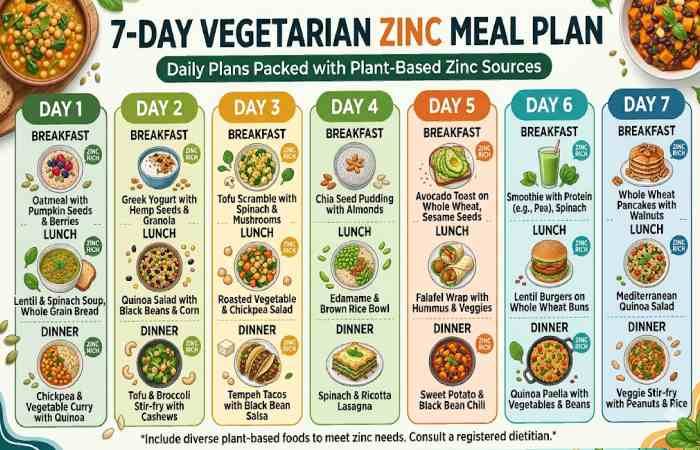
Day 1 – Balanced Zinc Start
| Meal | Foods | Key Zinc Sources |
| Breakfast | Oatmeal with pumpkin seeds, almond milk, and berries | Oats, pumpkin seeds |
| Snack | Greek yogurt with walnuts | Yogurt, walnuts |
| Lunch | Quinoa salad with chickpeas, cucumber, olive oil | Quinoa, chickpeas |
| Snack | Apple with peanut butter | Peanuts |
| Dinner | Lentil curry with brown rice and spinach | Lentils |
Estimated zinc: ~10 mg
Day 2 – Protein & Seeds Focus
| Meal | Foods | Key Zinc Sources |
| Breakfast | Whole grain toast with avocado and sesame seeds | Sesame seeds |
| Snack | Smoothie with banana, chia seeds, almond milk | Chia seeds |
| Lunch | Chickpea vegetable stir-fry with quinoa | Chickpeas |
| Snack | Handful of cashews | Cashews |
| Dinner | Tofu vegetable bowl with brown rice | Tofu |
Estimated zinc: ~9–11 mg
Day 3 – Legume Power Day
| Meal | Foods | Key Zinc Sources |
| Breakfast | Yogurt parfait with granola and raspberries | Yogurt, oats |
| Snack | Pumpkin seed trail mix | Pumpkin seeds |
| Lunch | Lentil soup with whole grain bread | Lentils |
| Snack | Kiwi and almonds | Almonds |
| Dinner | Black bean tacos with avocado | Beans |
Estimated zinc: ~10 mg
Day 4 – Whole Grain Nutrition
| Meal | Foods | Key Zinc Sources |
| Breakfast | Smoothie bowl with hemp seeds | Hemp seeds |
| Snack | Cottage cheese with berries | Dairy |
| Lunch | Brown rice bowl with tofu and vegetables | Tofu |
| Snack | Roasted chickpeas | Chickpeas |
| Dinner | Quinoa stuffed peppers | Quinoa |
Estimated zinc: ~9 mg
Day 5 – High-Fiber Zinc Diet
| Meal | Foods | Key Zinc Sources |
| Breakfast | Oatmeal with cashews and banana | Oats, cashews |
| Snack | Apple with almond butter | Almonds |
| Lunch | Chickpea spinach curry with brown rice | Chickpeas |
| Snack | Yogurt with flax seeds | Dairy |
| Dinner | Lentil pasta with tomato sauce | Lentils |
Estimated zinc: ~10–11 mg
Day 6 – Plant Protein Variety
| Meal | Foods | Key Zinc Sources |
| Breakfast | Whole grain toast with peanut butter | Peanuts |
| Snack | Trail mix with pumpkin seeds and almonds | Pumpkin seeds |
| Lunch | Quinoa chickpea salad | Quinoa |
| Snack | Pomegranate bowl with yogurt | Dairy |
| Dinner | Tofu stir-fry with vegetables and rice | Tofu |
Estimated zinc: ~9–10 mg
Day 7 – Zinc Boost Day
| Meal | Foods | Key Zinc Sources |
| Breakfast | Smoothie with oats, chia seeds, banana | Oats |
| Snack | Cashews and berries | Cashews |
| Lunch | Lentil quinoa bowl with vegetables | Lentils |
| Snack | Avocado toast with sesame seeds | Sesame |
| Dinner | Chickpea vegetable curry with brown rice | Chickpeas |
Estimated zinc: ~10 mg
Common Mistakes Vegetarians Make With Zinc Intake
Although zinc can be found in numerous plant foods, vegetarians occasionally fail to adequately fulfill their needs in terms of zinc and its daily intake because of the eating habits or weak supplementary absorption plans. To prevent the following pitfalls, it may be possible to stay healthy by proper zinc intake.
Relying Too Much on Refined Grains
Many vegetarians depend heavily on foods like white rice, white bread, and processed pasta. These refined grains contain significantly less zinc compared to whole grains.
Better choice:
- Brown rice
- Quinoa
- Whole wheat bread
- Oats
Whole grains provide more zinc, fiber, and other essential minerals.
Not Including Seeds and Nuts Regularly
Seeds and nuts are some of the richest plant-based zinc sources, yet they are often missing from vegetarian diets.
Examples of high-zinc options:
- Pumpkin seeds
- Hemp seeds
- Sesame seeds
- Cashews
- Almonds
Adding just 1–2 tablespoons of seeds daily can significantly boost zinc intake.
Ignoring Food Preparation Techniques
Plant foods contain phytates, compounds that bind to zinc and reduce absorption. Many vegetarians overlook preparation methods that reduce these compounds.
Helpful techniques include:
- Soaking beans and legumes
- Sprouting grains and seeds
- Fermenting foods like tempeh or sourdough bread
These methods improve mineral bioavailability.
Not Eating Enough Protein-Rich Plant Foods
Protein-rich foods like legumes, lentils, chickpeas, and beans are also important zinc sources. Diets low in these foods may lead to insufficient zinc intake.
Try to include at least one serving of legumes in every meal.
Examples:
- Lentil soup
- Chickpea salad
- Bean burrito bowls
Excessive Fiber Without Balance
While fiber is healthy, extremely high-fiber diets can interfere with mineral absorption, including zinc.
Balance your diet with:
- Nuts and seeds
- Protein sources
- Healthy fats
This helps maintain proper nutrient absorption.
Skipping Fortified Foods
Fortified foods can help vegetarians meet nutrient needs but are often overlooked.
Examples include:
- Fortified breakfast cereals
- Fortified plant milks
- Nutritional yeast
These foods may provide additional zinc and other micronutrients.
Not Monitoring Zinc Deficiency Symptoms
Many vegetarians do not recognize early signs of zinc deficiency.
Possible symptoms include:
- Weak immune system
- Hair thinning
- Slow wound healing
- Skin issues
- Reduced appetite
If these symptoms appear, improving diet or consulting a healthcare professional may help.
Depending Only on Supplements
Some people rely solely on supplements instead of food sources. While supplements can help in certain situations, whole foods provide better nutrient balance and additional health benefits.
A combination of zinc-rich plant foods and balanced meals is usually the best approach.
FAQ
What vegetarian food has the most zinc?
Pumpkin seeds, hemp seeds, chickpeas, lentils, and cashews are among the highest zinc plant foods.
Can vegetarians get enough zinc from food?
Yes. A well-planned vegetarian diet containing legumes, seeds, nuts, and whole grains can provide adequate zinc.
Are zinc supplements necessary for vegetarians?
Not always. Supplements may help people with deficiency, restricted diets, or higher requirements.
Which fruit is highest in zinc?
Fruits contain very little zinc, but avocados and blackberries provide small amounts.
How can vegetarians increase zinc absorption?
Soaking, sprouting, fermenting foods, and pairing with vitamin C-rich foods improves absorption.
Final Conclusion
Consumption of adequate amounts of zinc on a vegetarian diet is not impossible under the proper dietary options. Regular intake of pumpkin seeds, lentils, chickpeas, cashews, oats, and quinoa will help vegetarians to not only satisfy their nutritional requirements but also maintain immunity, metabolism, and health in general. As long as food is well prepared and the meals balanced, zinc rich foods vegetarian diets can easily provide the best nutrition and well-being in the long run.
Kashifa Jafar is a health, wellness and lifestyle writer at TheSparkShops with 4+ years of experience in content writing and digital publishing. She covers healthy living, wellness, food, natural beauty, organic products, sustainable living and everyday lifestyle topics in a clear and reader-friendly format.
Sameena Begum is a health, wellness and lifestyle content reviewer at TheSparkShops with 8 years of editorial experience. She reviews selected content for clarity, readability, organisation, consistency and overall editorial quality.